

Dolphin House
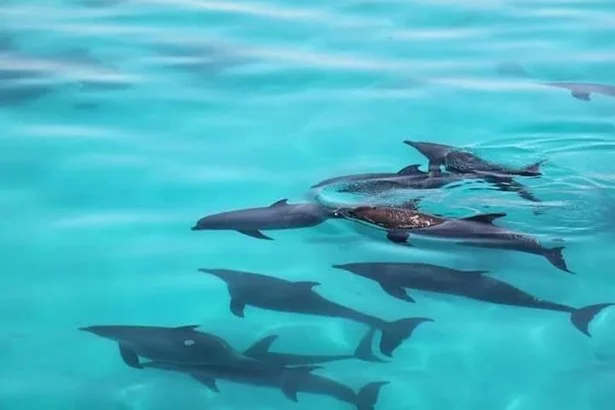
In Egypt's southern Red Sea there is a horseshoe-shaped reef called Sataya. Most people know it as Dolphin House. The reef wraps around a sheltered lagoon, and spinner dolphins come into that lagoon during the day to rest.
The reef
Sataya's walls drop steeply to a sandy slope scattered with coral heads, from 4 to 40 metres deep. Besides the dolphins you can meet whitetip sharks, fusiliers, Spanish dancers and parrotfish. For snorkellers it is a very good reef.
The dolphins
Spinner dolphins live in groups. They are named for their leaps: a dolphin twists out of the water and can spin two to seven times in one jump. They feed in deep water at night and rest in shallow, sheltered water by day. At Sataya, the groups come into the resting area at dawn and leave before dusk.
Nobody trains them and nobody feeds them. If you see them, it is because they chose to be there.
Watching without disturbing
The lagoon is where the dolphins rest. A 2018 study at Sataya found that boats and swimmers break that rest, most of all around midday. So we keep our distance and let the dolphins decide. We never chase, touch or feed them, and we never promise a sighting. Some days they pass close by. Some days they stay away.
Time at sea
Time outdoors, gentle exercise and a break from screens and meetings help many people relax, and floating in warm, clear water is a good way to get all three. That is the point of the week. It is not dolphin-assisted therapy, and an encounter is not a medical treatment.
Seven nights from Port Ghalib
Our Sataya Dolphins Cruise sails on MY Anemone, Saturday to Saturday, from Port Ghalib and back. Every day there are snorkelling and freediving sessions, and coaches lead breathwork, meditation and mindful movement. Diving is optional. Between sessions you can read on deck or do nothing at all. Direct transfers to and from the yacht are included, and children are welcome. The weather, the sea, the dolphins and the site rules decide what happens on any given day.
Source: Wikipedia — Spinner dolphin · Fumagalli et al. (2018), Royal Society Open Science